NewsTracker Answers for week of Jan. 02, 2006

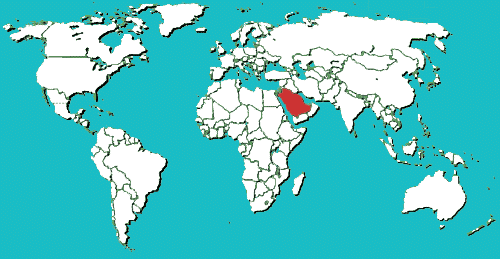
Q: Two million Muslims from around the world, including tens of thousands from the United States, are heading to Mecca on a spiritual journey. They'll converge on Mount Arafat, a revered site near Mecca, for the annual hajj pilgrimage that begins Jan. 10. Islamic law says that adult Muslims must make at least one pilgrimage to Mecca (Makkah in Arabic) if health and finances alllow.Where in the world is Mecca?

Circle the area on this map


Q: Many pilgrims come from countries around Saudi Arabia, where Mecca is located. Which of these does NOT share a border with Saudi Arabia?

A. Jordan

B. Iraq

C. Oman

D. Iran


D. The country's northern neighbors are Jordan, Iraq and Kuwait. The Persian Gulf and United Arab Emirates touch it on the east, while Oman and Yemen are to the south. The Red Sea is on its western side.


Q: Islam's holiest shrines are in Saudi Arabia, but it doesn't rank among 10 nations with the largest number of Muslims. Which country has the most members of that faith?

A. Nigeria

B. Indonesia

C. India

D. Turkey


B. Indonesia has nearly 213 million Muslims, who make up 88 percent of its population.
Pakistan ranks No. 2, followed by India.

Saudia Arabia has 20.8 million Muslims. That's fewer than Morocco in north Africa, which has the 10th-largest Muslim population.


Q: Jabal Sawda' in southwestern Saudi Arabia is . . .

A. The capital

B. A large desert

C. A historic oasis

D. The tallest peak


D. The country's highest point is Jabal Sawda', which reaches 10,279 feet.

The capital is Riyadh, a city of 4.5 million people, and the world's largest desert is the the Rub' al Khali in southern Saudi Arabia (600 miles long and 300 miles wide).


Q: Saudi Arabia's most important natural resource is . . .

A. Sand

B. Date palm trees

C. Oil

D. Natural gas


C. Saudi Arabia, the largest oil-exporter, has one-fourth of the world's known petroleum reserves.
Oil accounts for about three-fourths of the country's annual income.