

Common Core State Standard
SL.CCS.1/2/3/4 Grades 6-12: An essay of a current news event is provided for discussion to encourage participation, but also inspire the use of evidence to support logical claims using the main ideas of the article. Students must analyze background information provided about a current event within the news, draw out the main ideas and key details, and review different opinions on the issue. Then, students should present their own claims using facts and analysis for support. FOR THE WEEK OF JULY 14, 2014 This only sounds like science fiction: Driverless cars roll closer to reality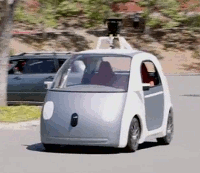

 Can you find news about other futuristic research or a gee-whiz product? List benefits and drawbacks of one.
 Pick a type of transportation in a photo, ad or article and tell how it has changed since your parents or grandparents were kids.
 Now look for someone in the news who has a job involving technology, inventions or making life better. What school subjects are used in that person’s work?
Engineers are testing small, cartoonish-looking cars that have no steering wheel, no accelerator and no brakes. The two-seat electric prototypes with a 25 mph top speed are driverless vehicles guided by software, cameras and sensors using radar and lasers. Google commissioned 100 of the models from a Detroit factory for road tests near its headquarters in Palo Alto, Calif. It hopes to persuade state officials to allow a wider pilot program there in coming years. On the outside, the experimental versions looks a bit like the ultracompact Fiat 500 or Mercedes-Benz Smart car. Inside are seatbelts, start and stop buttons and a screen that shows the pre-programmed route – but none of the regular controls that drivers touch. Because the route is preset, impulsive changes can't be made without stopping and entering a new destination. The car knows exactly where it is within a few centimeters – though only on roads already mapped in Google's database. The company still is many miles away from solving the challenge of driving in rain, fog or snow that could impede the electronic sensors, which "see" about 600 feet in all directions on a clear day or night. Google isn't the only company that envisions self-driving cars in our future. Ford is working on a car able to park itself in a curbside space. Mercedes showed a driverless prototype at a German auto show last fall, and two other European automakers – Volvo and Audi – also are doing research. In Japan, Nissan predicts it will sell no-driver cars by 2020.
Front Page Talking Points is written by
Alan Stamm for NIEonline.com, Copyright 2026
Front Page Talking Points Archive►Deadly Ebola outbreak in Africa affects travel to the United States, including for World Cup ►Communities Push Back Against Massive AI Data Centers ►Script handwriting comeback: 2 more states now require school penmanship lessons ►U.S. health secretary changes tone on childhood measles shots ►‘Our Power, Our Planet:’ Earth Day brings reminder of need to protect Earth from ourselves ►Federal case brings verdict that Live Nation and Ticketmaster illegally overcharge concert fans ►An El Niño weather system expected this summer or fall could affect the U.S. ►Artemis II this week takes four astronauts farther from Earth than anyone has traveled ►Social media giants lose two lawsuits blaming them for serious risks to young users ►Wartime news reports fuel fresh strains between U.S. government and the media |
 Test passenger says: "It felt a lot like a theme park ride. . . . I didn't feel unsafe in the least. The car braked for jaywalkers, paused when it was coming around a curve and couldn't see whether the light in front of us was green or red, and skittered when it worried that a bus might be turning into our lane." – Liz Gennes at re/code blog