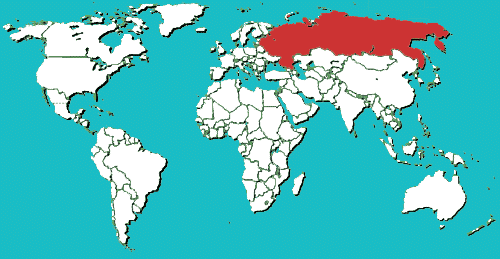
Circle the area on this map

C. A kremlin is is a major fortified central complex found in historic Russian cities. The word usually refers to the Moscow Kremlin which housed the government of the Soviet Union during the Cold War. Russia's presidential administration is located in the Moscow Kremlin, but the rest of the government now occupies a building outside it.
A. Saint Petersburg was founded by Tsar Peter the Great in 1703 and it served as the Imperial capital of Russia from 1713 to 1728 and from 1732 to 1918. In 1924, the city was renamed Leningrad after communist revolutionary Vladimir Lenin. The name was changed back to Saint Petersburg in 1991 after the communist Soviet Union crumbled.
D. Security experts said it appears that a botnet of hijacked PCs were used in an attempt to drown out Twitter chat about the Russian protests. Egypt's fallen government blocked social media sites in a vain attempt to choke off protests. Government leaders in Britain talked about censoring social media after anti-government riots. And, U.S. lawmakers proposed a bill that would allow the government to shut down civilian access to the internet in an emergency.
B. Putin joined the KBG in 1975 after graduating from Leningrad State University, and he resigned from the agency in early 1992 after a KGB-supported coup failed to oust Soviet President Mikhail Gorbachev.