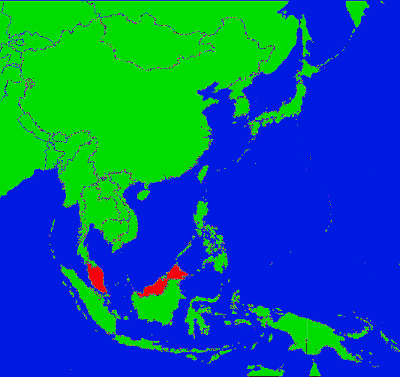
Circle the area on this map

C. The South China Sea is part of the Pacific Ocean encompassing an area from the Strait of Taiwan to the Strait of Malacca, which separates the Malay Peninsula from the Indonesian island of Sumatra to the southwest. The Strait of Malacca is the main shipping channel between the Pacific Ocean and Indian Ocean.
B. Singapore was briefly part of Malaysia when it was formed in 1963. Singapore and Malaysia were British colonies before their independence. Their governments are modeled on the British parliamentary system and their laws are based on English Common law.
D. All three nations have security laws that allow them to imprison people indefinitely. The United Sates has indefinitely held more than 300 people at its naval base in Guantanamo Bay, Cuba, for nearly a decade. Those prisoners are from other countries, but Congress passed a defense bill last year that allows the indefinite detention of U.S. citizens without trial.
A. Habeas corpus, Latin for "you have the body," is a writ requiring that a detained person be brought before a judge. It requires that a prisoner be released from unlawful detention, that is, detention lacking sufficient cause or evidence. It has historically been an important legal instrument safeguarding the freedom of individuals against arbitrary state action.