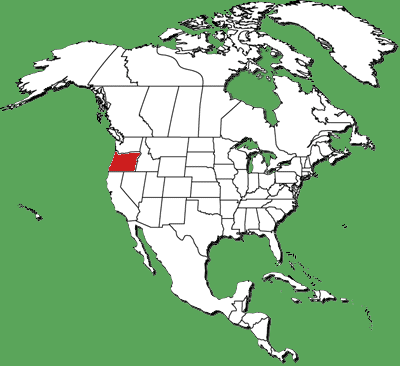
Circle the area on this map

D. A schoolboy's soccer ball washed up on Middleton Island, Alaska. The U.S. Coast Guard used cannon to sink a crewless Japanese ship off Sitka, Alaska. And, a Harley-Davidson motorbike swept away by the tsunami was found inside a container on a beach in Canada.
B. The motorcycle came ashore on Graham Island off the coast of mainland British Columbia. The Alberta province is on British Columbia's eastern border, and the Yukon Territory is on its northern border. Prince Edward Island is one of Maritime provinces on Canada's Atlantic Coast.
C. A 9.0 magnitude earthquake off the shore of Japan created the wall of water that devastated the coast. A tsunami -- a series of water waves caused by the displacement of a large volume of a body of water -- can be caused by earthquakes, volcanic eruptions, landslides and underwater explosions, including nuclear detonations.
A. A starfish native to Japan was among the marine life still clinging to the structure. John Chapman, a research scientist at Oregon State University said hundreds of other organisms, such as tiny crabs and algae, posed a "very clear threat."