NewsTracker Answers for week of June 18, 2012

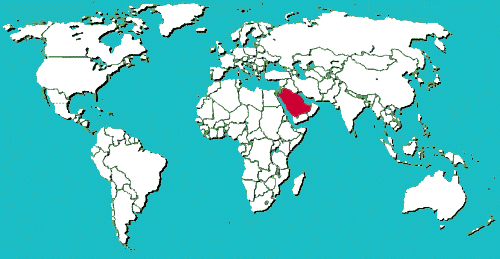
Q: Prince Nayef bin Abdul Aziz al-Saud died last week at 78. He was the second Saudi crown prince to die in the last eight months. Where is Saudi Arabia on this map?

Circle the area on this map


Q: The prince was the brother of the 88-year-old reigning monarch, King Abdullah. The succession in Saudi Arabia still passes among the sons of former King Abdul Aziz al-Saud, who established the modern kingdom during his reign from 1932 to 1953. How did Abdul Aziz ibn Saud become king?

A. Armed conquest

B. Elected by the people

C. Selected by sheiks

D. Picked by colonial rulers


A. Ibn Saud waged a 30-year campaign to unify the country and make himself king.


Q: So far, five of King Abdul Aziz al-Saud's sons have become kings and about 20 are still alive. Saudi Arabia is one of few nations ruled by absolute monarchs who wield unrestricted political power over their people and state. Which of these is ruled by an absolute monarch?

A. Nepal

B. United Kingdom

C. Vatican City

D. All of the above


C. Although the Pope is elected by the College of Cardinals, he rules as supreme over the Vatican City State. The United Kingdom of Great Britain and Northern Ireland is a constitutional monarchy where political power is held by parliament. Nepal's monarchy was abolished in 2008.


Q: Prince Nayef was buried in the Islam's most holy city . . .

A. Riyadh

B. Baghdad

C. Jerusalem

D. Mecca


D. As the birthplace of Muhammad and a site of the composition of the Quran, Mecca in Saudi Arabia is regarded as the holiest city in Islam. The Hajj, a pilgrimage to the city, is obligatory for all able Muslims.


Q: When it was created in 1932, the kingdom of Saudi Arabia was one of the poorest countries in the world, reliant on limited agriculture and pilgrimage revenues. Oil was discovered in 1938, and the nation now has the world's largest proved oil reserves. Which nation is second?

A. Afghanistan

B. Iraq

C. Venezuela

D. United States


C. With 211 trillion barrels of oil, Venezuela in South America is second only to Saudi Arabia's 262 trillion barrels. Iraq ranks fifth, and the United States is 13th. Afghanistan has no proved oil reserves.