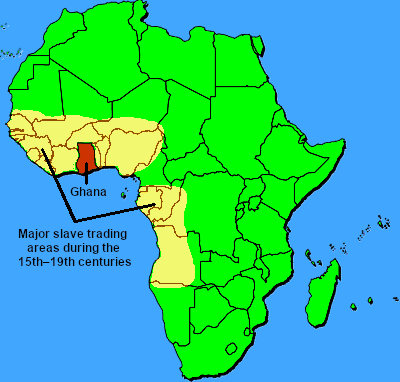
Circle the area on this map

B. Brazil (Portuguese America) was the destination of an estimated 38.5% of Africans sold as slaves. The second-most common destination was the British West Indies, followed by the Spanish Empire, the French West Indies, the United States (British North America), the Dutch West Indies, and the Danish West Indies.
D. In 1526, 300 Spanish colonialists brought 100 African slaves in an attempt to establish a colony somewhere on the coast of what is now South Carolina or Georgia. Within a few months, 200 Spaniards and 30 enslaved Africans died. The remaining slaves rebelled and joined a Native American tribe. Spain soon abandoned the colony.
A. Mauritania in northwest Africa became the last country in the world to officially abolish slavery, when a presidential decree abolished the practice in 1981. On the Arabian Peninsula, Saudi Arabia and Yemen abolished slavery in the 1960s, and Oman outlawed it in 1970. While officially illegal, various forms of slavery and forced labor persist around the world.
A. Slavery had existed in Africa for centuries before Europeans began colonizing the American continents and went looking for laborers. African slave traders sold captured people to European and American ships at forts built along the Atlantic Coast, including what is now Ghana. Between 1.2 and 2.4 million Africans died while being shipped as cargo to the Western Hemisphere.