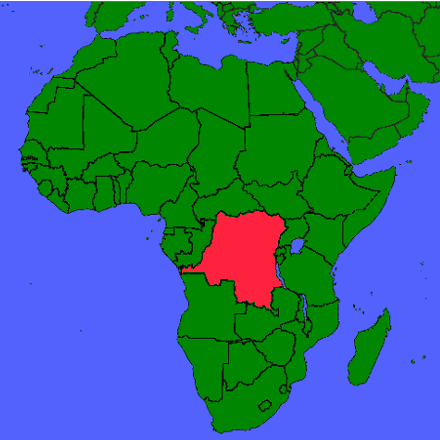
Circle the area on this map

C. Uganda has reported five cases of Ebola. DR Congo borders Uganda, Rwanda, Burundi, and Tanzania to the east; Zambia and Angola to the south; the Republic of Congo and Atlantic Ocean to the west; and the Central African Republic and South Sudan to the north. The region is densely populated and one of the world’s poorest areas.
B. When you divide all of Burundi’s production of goods and services by the number of its people, it amounts to $1,031 per person. The Central African Republic and South Sudan are the world’s next poorest nations, according to the International Monetary Fund’s 2026 list. Angola is DR Congo’s wealthiest neighbor with a GDP per person of $10,446. That figure is $94,430 in the United States.
D. That first outbreak killed at least 151 people in what is now South Sudan. Scientists believe it originated in a cotton factory where workers had contact with bats in warehouses. A month later, the disease struck a remote village near the Ebola River in what is now DR Congo. The disease was named after the river, which is a tributary of the Congo River.
A. For every 100,000 people in the Central African Republic, 754.8 died from infectious diseases. That was more than twice as many people as the 360.8 deaths per 100,000 in DR Congo. The infectious disease death rate for the United States was 23.8 per 100,000 people in 2023. Tuberculosis kills more people than any other infection – over 4,300 people a day around the globe.